
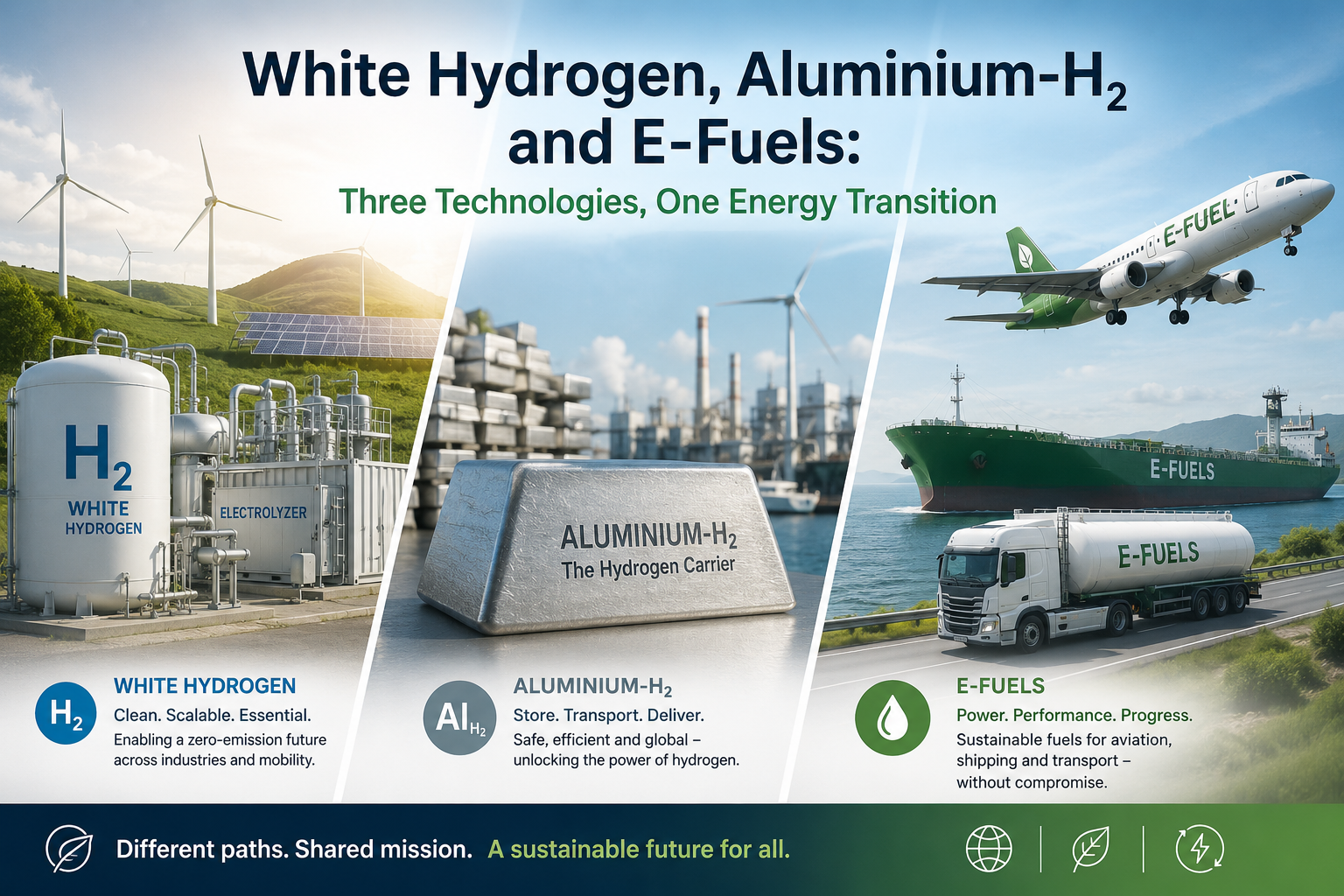

White Hydrogen, Aluminium-H₂ and E-Fuels:
Three Technologies, One Energy Transition
White hydrogen, aluminium-hydrogen storage and synthetic e-fuels are three technologies that are often discussed separately. They are in reality deeply complementary — each one solving a problem the others cannot. White hydrogen provides the cheap feedstock. E-fuels convert it into drop-in liquid fuels for aviation and heavy transport. Aluminium-hydrogen provides solid-state storage for applications where neither electricity nor compressed gas is practical. Together they form a coherent pathway to deep decarbonisation of the sectors hardest to electrify.
Three Technologies — Each Solving a Different Problem
The Cost Equation — Why White Hydrogen Changes Everything
The fundamental economic challenge for both e-fuels and aluminium-hydrogen systems is the same: the cost of hydrogen. At current electrolytic green hydrogen prices of €6.20/kg in Europe, e-kerosene costs approximately €7.70/L — roughly nine times the price of fossil jet fuel. This gap cannot be closed by efficiency improvements alone. The chemistry is fixed; the feedstock cost is the dominant variable.
White hydrogen — if confirmed at commercial scale at the projected cost of €0.50–1.50/kg — transforms the economics of both downstream technologies simultaneously. E-kerosene falls to approximately €3.00/L. E-petrol falls to approximately €1.80/L, approaching pump parity. Green ammonia falls toward fossil ammonia price parity. The entire downstream cost structure shifts in a single step.
| Technology | Cost today | Cost with white H₂ (est.) | Competitiveness | Timeline |
|---|---|---|---|---|
| White hydrogen | Not yet commercial | €0.50–1.50/kg projected | Transformative if confirmed | 2030–2035 |
| E-kerosene | €7.70/L | ~€3.00/L | Viable with mandates | 2032–2038 |
| E-petrol | €3.40/L | ~€1.80/L | Near pump parity | 2033–2040 |
| Al-air backup power | Commercial (niche) | Improves with cheap Al | Already competitive vs diesel | Now → 2030 |
| Green ammonia | €700–900/t | ~€200–300/t | Near fossil parity | 2030–2035 |
Investment Flows — Where the Money Is Going in 2026

The Regulatory Barriers — What Is Actually Blocking Progress
- White hydrogen — mining law ambiguity: In most European countries, natural hydrogen has no legal status in mining codes. Who owns it? How are permits granted? France’s “Trois Évêchés” permit (January 2026) is Europe’s first — but the framework is still being built.
- White hydrogen — renewable classification: RED III requires e-fuel hydrogen to come from “renewable” sources. If white hydrogen is classified as a non-renewable mineral resource, e-fuels produced from it may not qualify for EU mandates — a critical policy question still unresolved.
- E-fuels — CO₂ certification: Only CO₂ from direct air capture or biogenic sources qualifies under EU rules. Industrial point-source CO₂ (steel, cement) may be phased out — restricting available feedstock and increasing costs.
- E-fuels — additionality rule: Hydrogen used for e-fuels must come from new renewable capacity, not existing grid electricity. This rule was designed for electrolytic hydrogen — its application to white hydrogen is legally unclear.
- Al-H₂ — no safety standards: No standardised certification framework exists for Al-H₂ generators in commercial buildings, ships or public infrastructure. This slows commercial deployment beyond defence and industrial niches.
- Al-H₂ — Al(OH)₃ waste classification: The aluminium hydroxide byproduct is subject to industrial waste regulations in many jurisdictions — adding logistical and administrative cost to the recycling cycle.
A Defended Timeline to 2050
The energy future will not belong to one technology. It will be an ecosystem where each molecule finds its natural place according to its physical properties. White hydrogen as the cheap feedstock. E-fuels for the air. Aluminium-hydrogen for the places where nothing else works.
hydrogen.al · Editorial analysis · June 2026The Honest Assessment
This triptyque analysis is intellectually compelling and the complementarity is real. But several caveats deserve clarity. The cost projections for white hydrogen at €0.50–1.50/kg are targets, not confirmed prices — they depend on geological and engineering conditions that have not yet been proven at commercial scale. The “symbiosis 2050” scenario assumes regulatory alignment that does not yet exist, particularly on the renewable classification of white hydrogen under RED III.
What is confirmed today: e-fuels work technically, are mandated by law, and have real commercial plants operating. Aluminium-air backup power is commercially deployed in data centers and being validated by hyperscalers. White hydrogen exists in measurable quantities in multiple geological settings. The cost and scale questions are real but answerable — and 2027 will provide significant data with REGALOR II results.
The triptyque is not guaranteed. But it is coherent, technically grounded, and increasingly well-funded. That combination is rare in energy transition technology.
- → Atawey — “Hydrogène blanc : projections et évolutions du secteur d’ici 2035” — September 2025
- → Koloma — $245M raise — natural hydrogen exploration — USA
- → FDE / REGALOR II — Lorraine · Pontpierre 3,655m — October 2025
- → Phinergy / Net Zero Innovation Hub — Al-air data center validation — December 2025
- → INERATEC ERA ONE — Frankfurt Höchst — commissioned June 2025
- → ReFuelEU Aviation Regulation — EU 2023/2405
- → EU RED III — Renewable Energy Directive — hydrogen additionality rules
- → BloombergNEF Battery Price Survey — green hydrogen €6.20/kg Europe 2026

Leave a Reply