
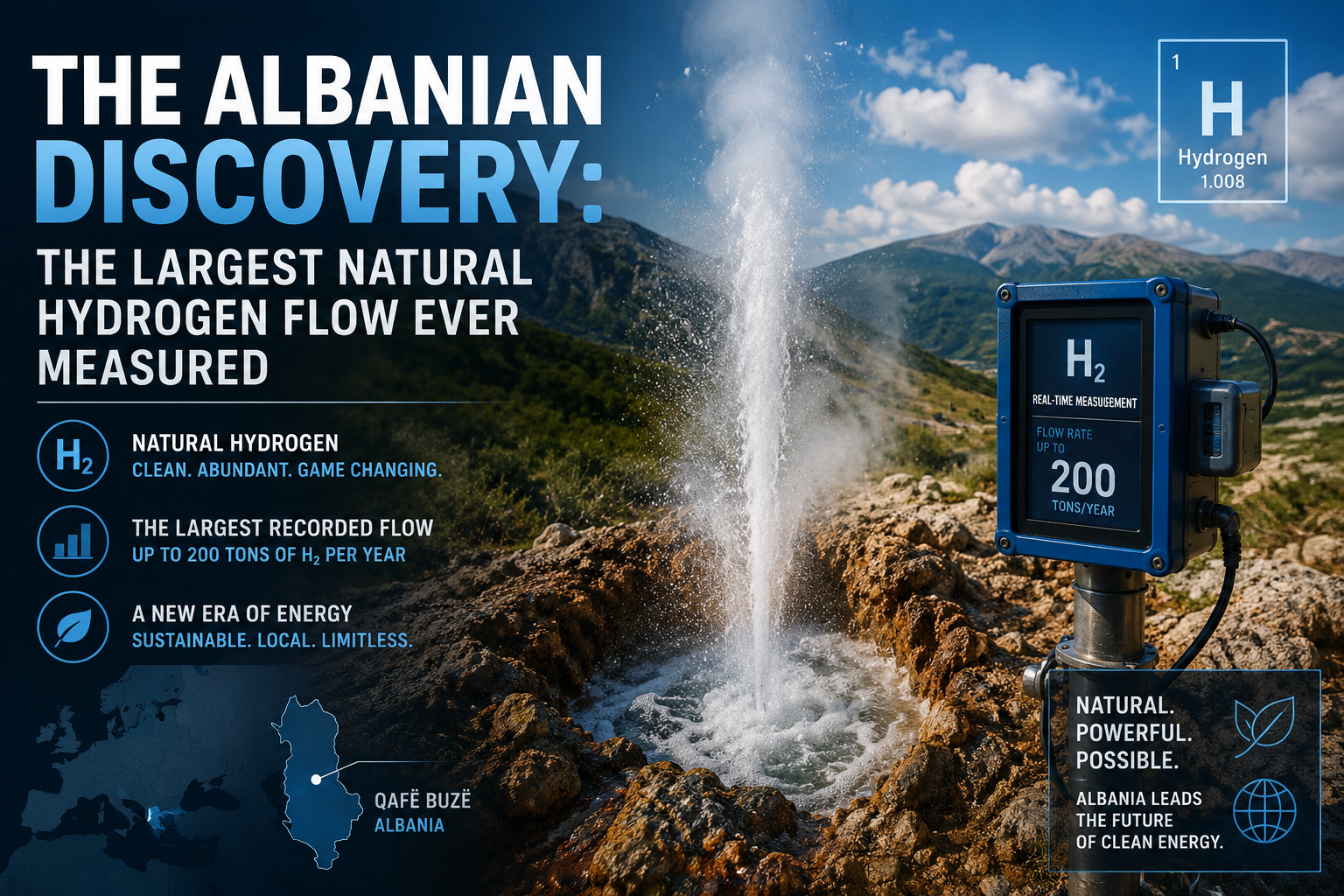

The Albanian Discovery:
The Largest Natural Hydrogen Flow Ever Measured
In February 2024, a team of geochemists from the Université Grenoble Alpes, CNRS and their Albanian colleagues published a landmark paper in Science — one of the world’s most prestigious scientific journals. Beneath the Bulqizë chromite mine in Albania, nearly one kilometre underground, they found a pool of water seething with hydrogen gas — described by those who witnessed it as a 30 m² jacuzzi bubbling with almost pure H₂. The flow rate was measured at a minimum of 200 tonnes per year at 84% purity. It was the largest natural hydrogen flow rate ever recorded at that time. This discovery changed the way the scientific world thinks about geological hydrogen.
The Mine — A Chromium Deposit That Hid a Hydrogen Secret
The Bulqizë mine, located approximately 40 kilometres northeast of Tirana, is one of the world’s largest chromium mines and one of Albania’s most important industrial assets. Since 2001, it has been owned by Empire Mining Corporation of Canada. It cuts deep into an ancient geological formation called an ophiolite — a fragment of Jurassic oceanic crust that was thrust onto the continental shelf millions of years ago when Africa collided with Europe and closed an ancient sea.
The mine has a troubled safety history. Since 1992, it has experienced at least three major explosions — in 2011, 2017, and 2023. For years, the cause was assumed to be methane, the gas typically associated with underground mining accidents. It was only when scientists gained access to the deepest galleries that the true culprit was identified: almost pure hydrogen gas, produced continuously by the geological reactions occurring in the iron-rich rocks surrounding the mine.

The Science — Why Ophiolites Produce Hydrogen
The geological explanation for Bulqizë’s hydrogen is serpentinisation — the same process responsible for natural hydrogen production in Lorraine, the Canadian Shield, and South Australia. The ophiolitic rocks surrounding the mine are rich in iron-bearing minerals (olivine, pyroxene). When groundwater percolates into these rocks at elevated temperatures and pressures, it reacts with the iron, oxidising it and releasing hydrogen gas as a continuous byproduct. The Bulqizë ophiolite is particularly well-suited to this process because it preserves a thick sequence of upper mantle rocks that have been in contact with groundwater for millions of years.
What makes Bulqizë exceptional is not the process itself — serpentinisation occurs in many places — but the presence of a fault zone acting as a natural reservoir. The researchers demonstrated through in-situ observations and numerical modelling that a deep, faulted reservoir rooted in the Jurassic ophiolite massif accumulates hydrogen produced over geological time and releases it progressively. The mine galleries have perforated this reservoir at several well-localised points, allowing scientists to measure the flow directly.
- Study — Truche et al. — “A deep reservoir for hydrogen drives intense degassing in the Bulqizë ophiolite” — Science, vol. 383, no. 6683, February 8, 2024
- Authors — Laurent Truche, Frédéric-Victor Donzé (ISTerre, Univ. Grenoble Alpes · CNRS) + Albanian colleagues (NANR-AKBN Tirana · Polytechnic University of Tirana)
- Measurement — 84% H₂ by volume · minimum 200 t/year · measured directly in mine galleries at ~950m depth
- Reservoir — deep faulted zone in Jurassic ophiolite massif · not just surface outgassing · genuine subsurface accumulation
- Formation mechanism — serpentinisation of iron-rich ultramafic rocks + fault-zone accumulation over geological time
- Economic assessment — 5,000–50,000 tonnes estimated in reservoir · too small for global-scale commercial exploitation · but a world-class scientific demonstration
- Safety history — three explosions since 1992 (2011 · 2017 · 2023) · previously attributed to methane · now confirmed as hydrogen
Why This Discovery Matters Beyond Albania — A Blueprint for Global Exploration
The Bulqizë discovery is not primarily about Albania’s energy supply. The measured flow of 200 tonnes per year is negligible compared to global hydrogen production of 100 million tonnes annually. What makes it scientifically transformative is what it demonstrates about the global distribution and accessibility of natural hydrogen.
The Albanian rocks are an ophiolite — a geological formation found on every continent. Ophiolites exist in France (Massif du Var), Morocco, Oman, New Caledonia, Papua New Guinea, Canada and many other locations. The Bulqizë study shows that ophiolites can contain real, measurable, accessible hydrogen reservoirs — not just traces. This provides a geological model that exploration geologists can apply worldwide.
These deposits have been ignored by the oil and gas industry for a very long time. This goes in the right direction.
Frieder Klein · Geochemist · Woods Hole Oceanographic Institution · Science, February 2024Michael Webber, an energy systems researcher at the University of Texas at Austin, noted that one key takeaway from the discovery is that hydrogen seems to be more ubiquitous than once imagined. This shift in scientific consensus — from “natural hydrogen is rare” to “natural hydrogen is widespread but underexplored” — is what the Bulqizë paper fundamentally achieved.
The Connection to Lorraine — Same Geology, Different Scale
The geological setting at Bulqizë — iron-rich ophiolitic rocks, serpentinisation, fault-zone accumulation — shares important characteristics with the Hercynian basement rocks underlying the Lorraine basin in northeastern France. The REGALOR II programme, operated by Française de l’Énergie and based on the decade-long research of CNRS geochemists Jacques Pironon and Philippe De Donato, identified hydrogen concentrations rising from 1% at 600 metres to 17% at 1,100 metres — with the REGALOR II borehole at Pontpierre reaching 3,655 metres in October 2025.
The Lorraine deposit — estimated at 92 million tonnes, roughly 400 times the estimated Bulqizë reservoir — is the same geological phenomenon at a very different scale. If the Bulqizë mine is the scientific proof of concept, Lorraine is the commercial-scale test. REGALOR II results are expected in 2027.
Why hydrogen.al — The Albanian Connection Is Not an Accident
This domain — hydrogen.al — is registered under Albania’s country code top-level domain (.al). For the majority of internet users, .al means Albania. For chemists and engineers, it reads as H + Al — hydrogen and aluminium. The Bulqizë discovery adds a third reading: hydrogen.al as a direct reference to the place where the world’s largest natural hydrogen flow was measured.
Three valid interpretations of the same eight-character domain. That convergence — geographical, chemical and geological — is what makes it genuinely unique.
- → Truche L. et al. — “A deep reservoir for hydrogen drives intense degassing in the Bulqizë ophiolite” — Science, vol. 383, no. 6683, p. 618–621 — February 8, 2024 — DOI: 10.1126/science.adk9099
- → Université Grenoble Alpes — “Discovery of a large hydrogen reservoir in an underground mine in Albania” — February 9, 2024
- → Science.org — “Gusher of gas deep in mine stokes interest in natural hydrogen” — February 8, 2024
- → Phys.org — “Largest flow of natural hydrogen gas ever found measured in Albanian chromium mine” — February 9, 2024
- → National Geographic — “This Albanian mine could help unlock the hydrogen economy” — March 7, 2024
- → PubMed — PMID 38330123 — Truche et al. — February 8, 2024
- → FDE / REGALOR II — Lorraine · Pontpierre 3,655m — October 2025

Leave a Reply