Hydrogen.al

H + Al — Aluminium-Hydrogen Energy Technologies

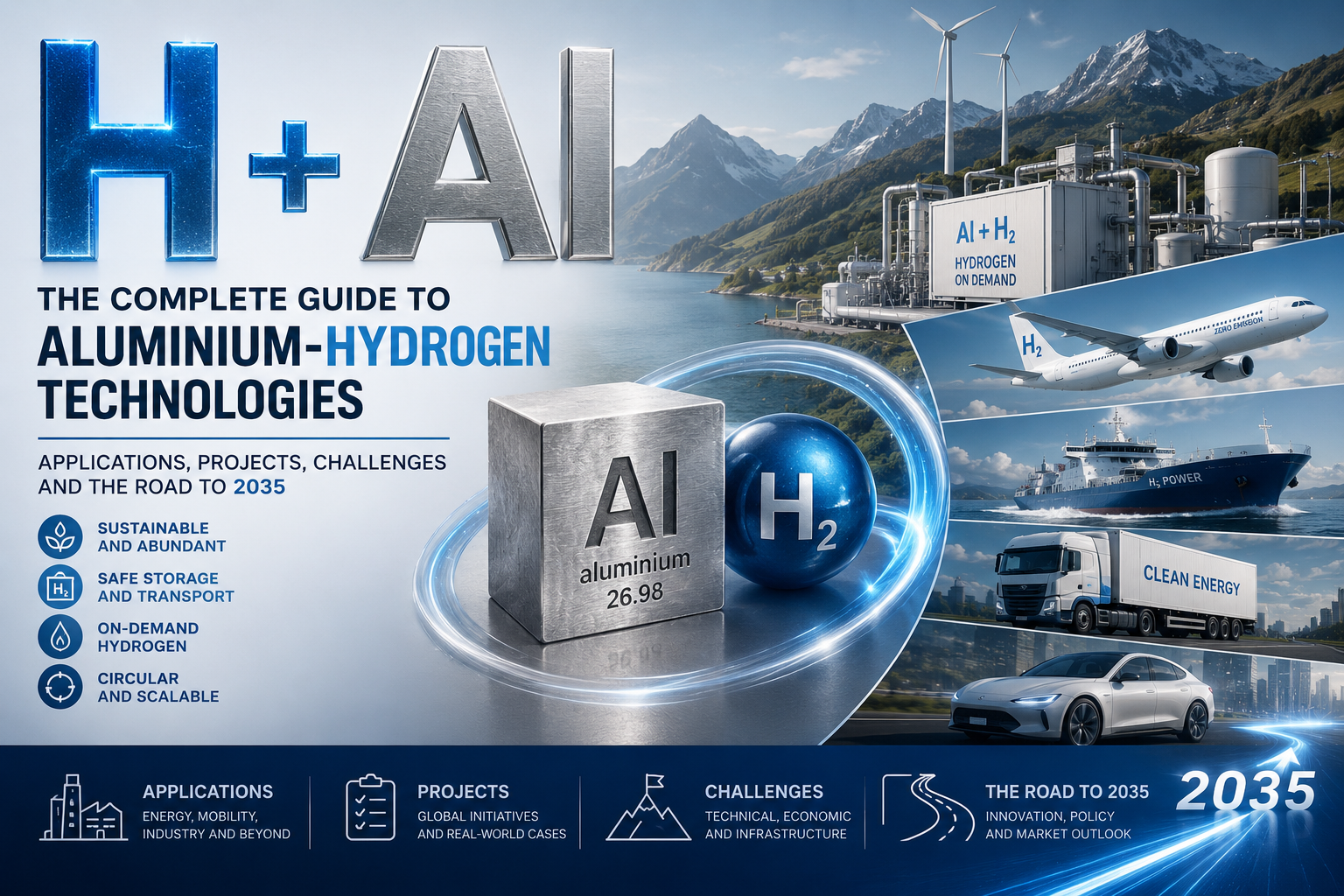
H + Al: The Complete Guide to Aluminium-Hydrogen Technologies — Applications, Projects, Challenges and the Road to 2035

H + Al: The Complete Guide to Aluminium-Hydrogen Technologies — Applications, Projects, Challenges and the Road to 2035 | hydrogen.al
aluminium hydrogen technology Al-H2 energy applications industrial
H + Al = hydrogen.al · the chemical domain

Aluminium + Hydrogen:
The Complete Guide to a Sovereign Energy Partnership

📅 June 8, 2026 ✍ hydrogen.al ⏱ 12 min read 🔬 Science · Industry · Projections

This domain — hydrogen.al — is not registered in Albania. For any chemist, metallurgist or energy engineer, it reads immediately as H (Hydrogen) + Al (Aluminium), the two universal chemical symbols for one of the most promising energy partnerships of the coming decade. This article documents everything that is currently known, confirmed, and defensibly projected about the aluminium-hydrogen couple — its chemistry, its real commercial applications, the companies building them, the honest challenges they face, and a defended timeline to 2035.

Editorial note on projections: This article distinguishes clearly between confirmed facts, current commercial projects, and forward projections. Market size figures and timelines for future applications are estimates based on available data and carry significant uncertainty. They should not be treated as forecasts.
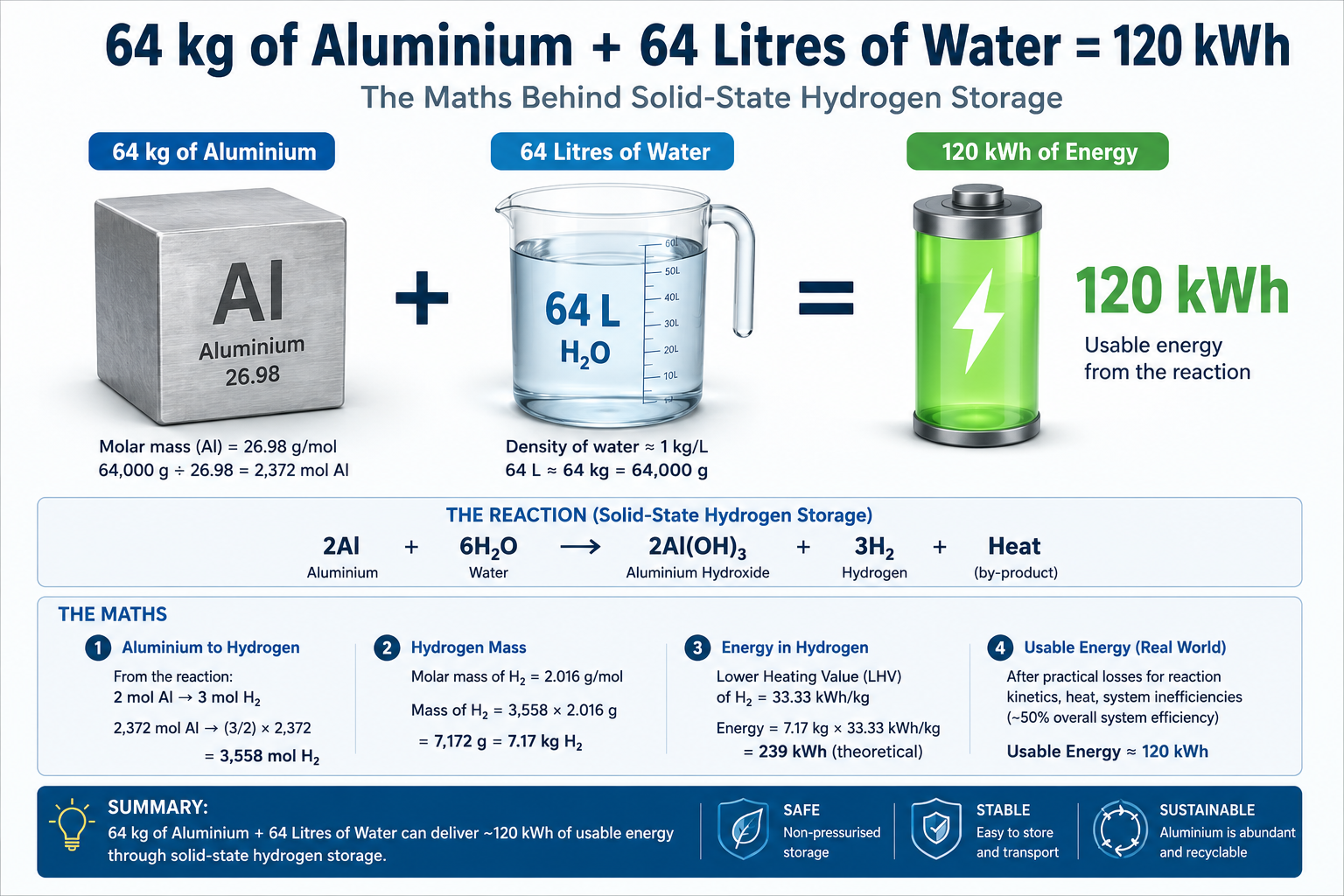
111 g H₂ produced per kg aluminium · confirmed chemistry
~31 MJ Total energy per kg Al reacted · 50% chemical · 50% heat
97% Aluminium recyclable after use · Al(OH)₃ → Al₂O₃ → Al
2009 Phinergy founded · Israel · 16 years of Al-air development

The Chemistry — What Happens When Aluminium Meets Water or Air

Aluminium is the third most abundant element in the Earth’s crust. Under normal conditions, it is protected by a thin, stable oxide layer (Al₂O₃) that forms instantly when the metal is exposed to air. This passivation layer prevents the metal from reacting — which is why aluminium does not corrode in everyday use. Breaking through this layer is the central challenge of Al-H₂ technology, and the key innovation behind every commercial application described in this article.

The Two Core Reactions — Al-H₂O and Al-Air
2 Al + 6 H₂O → 2 Al(OH)₃ + 3 H₂ ↑ + Heat
Al-water reaction: 1 kg aluminium produces ~111 g H₂ (1.24 m³ gas) + ~15-16 MJ heat · requires activation to bypass oxide layer · basis of H₂ generator technology

4 Al + 3 O₂ → 2 Al₂O₃ + Electricity
Al-air reaction: aluminium reacts with ambient oxygen → electricity generated directly · no H₂ intermediate · basis of Phinergy battery technology · byproduct Al₂O₃ recyclable to aluminium

AlH₃ → Al + 3/2 H₂ (on gentle heating above ~100°C)
Alane (aluminium hydride): solid compound · 10.1% H₂ by weight · 2× energy density of liquid H₂ · basis of solid-state hydrogen storage research

How Scientists Bypass the Oxide Layer — Three Confirmed Methods

Three principal methods have been demonstrated at laboratory or pilot scale to activate aluminium for reaction with water. Gallium alloying — adding a small amount of liquid gallium to aluminium — disrupts the oxide layer at grain boundaries, allowing water to reach the pure metal beneath. The MIT group demonstrated near-100% conversion efficiency at 55–100°C using this method. Gallium is recoverable and reusable, but expensive.

Alkali activation — dissolving aluminium in sodium or potassium hydroxide solution — chemically destroys the oxide layer. Simple and cheap, but produces aluminate rather than pure hydrogen gas. Mechanical activation — ball-milling aluminium powder with activating salts — creates fresh reactive surfaces before the oxide can reform. This is the method used in commercial Al-H₂ cartridge systems: stable dry powder that reacts vigorously when water is added.

activated aluminium powder laboratory research hydrogen generation water reaction
Activated aluminium powder — ball-milled with activating agents · reacts with water on contact to release hydrogen gas · basis of commercial Al-H₂ cartridge systems · shelf-stable for years in dry storage · Photo: Unsplash

The Energy Yield — What One Kilogram of Aluminium Can Do

Energy from 1 kg Aluminium — Confirmed Data
1 kg Al + H₂O → ~31 MJ total energy
50% — Chemical (H₂)
~15 MJ
Hydrogen gas · capturable as fuel · combustion or fuel cell · ~2 kWh electricity via 50% efficient fuel cell
50% — Thermal (Heat)
~16 MJ
Direct heat release · recoverable for cogeneration · ~6 kWh thermal in full cogeneration system
Full cogeneration system efficiency: 80–90% · MIT activation: ~100% Al conversion at 55–100°C · Source: peer-reviewed literature

Six Real Applications — From Confirmed Commercial to Early Stage

🔋
Al-Air Battery — Backup Power
TRL 7-8 · EARLY COMMERCIAL
Aluminium plates react with ambient oxygen to generate electricity directly. Multi-day resilience vs hours for Li-ion. Phinergy validated by Net Zero Data Centers Hub (Google, Microsoft, Danfoss, Schneider) December 2025. NYPA + Phinergy $1.5M BIRD grant for US commercial demonstration.
Phinergy (Israel, NASDAQ) · IOC Phinergy (India JV)
🚁
Al-H₂ Drone Fuel Cell
TRL 6-7 · PILOT COMMERCIAL
Al-H₂ cartridges power fuel cells for long-endurance UAVs. Cellen H2 H2-6 drone: 150 min endurance vs 25 min battery. No compressed H₂ tank needed — aluminium powder activates with water on board. BVLOS regulation opening 2026–2027 expected to accelerate demand.
Cellen H2 Inc. · Intelligent Energy · Chinese Academy of Sciences
🚗
Al-Air EV Range Extender
TRL 5-6 · PILOT
Al-air battery as range extender in EVs — plate swap instead of charging. Hindalco + Phinergy + Indian Oil Corporation MoU June 2025 for Al-air EV batteries in India. Target: 1,000 km range via plate replacement at service points. Leading Indian automakers testing.
Hindalco · Phinergy · Indian Oil Corporation
Portable H₂ Generator
TRL 5-6 · PILOT
Compact cartridges of activated Al powder produce H₂ on demand when water added. No electrolysis, no compression, no pressure vessel. Shelf-stable for years. Applications: remote sites, military, maritime emergency, expeditions. Found Energy (US) raising funds for commercialisation.
Found Energy (US) · various defence contractors
🏭
H₂-Fired Al Recycling
TRL 8-9 · INDUSTRIAL
Using green hydrogen as furnace fuel to remelt aluminium scrap — eliminating CO₂ from the melting process. Fives Group + Hydro produced the world’s first industrial-scale batch of H₂-recycled aluminium June 2023. The application is the inverse: H₂ decarbonises Al production.
Fives Group · Norsk Hydro
🔄
Solid Alane H₂ Storage
TRL 3-4 · RESEARCH
Alane (AlH₃): solid compound storing 10.1% H₂ by weight — 2× the energy density of liquid hydrogen. Releases H₂ cleanly above ~100°C. Researched for vehicles and aviation where compressed H₂ tanks are impractical. Regeneration cost is the main unsolved challenge.
Multiple university research groups · US DOE programme

The Paradox — When Hydrogen Is the Enemy of Aluminium

There is a striking paradox in the Al-H₂ story. In the five applications above, hydrogen is either the desired product or the energy carrier. But in the aluminium foundry industry, hydrogen is one of the most feared contaminants.

When aluminium is melted, it readily dissolves hydrogen from atmospheric moisture. As the metal cools, hydrogen solubility drops sharply and the dissolved gas forms microscopic bubbles — creating porosity that weakens the casting. Foundry engineers spend significant effort degassing molten aluminium using rotating impellers that bubble inert gases through the melt to carry dissolved hydrogen to the surface.

The same couple — aluminium and hydrogen — with two completely opposed industrial relationships depending entirely on the application. This is what makes hydrogen.al such an accurate chemical domain name: it captures both faces of the partnership without privileging either.

aluminium foundry degassing molten metal hydrogen contamination industrial metallurgy
Aluminium foundry — degassing molten aluminium to remove dissolved hydrogen before casting · rotating impeller system · hydrogen is a contaminant in metallurgy but an energy carrier in clean energy applications · the same couple · two opposite industrial roles · Photo: Unsplash

Al-H₂ vs Competing Technologies — An Honest Comparison

Dimension Al-H₂ System Li-ion Battery Solid-State Battery Compressed H₂
Energy density High · Al: ~8 kWh/kg theoretical Low · ~0.3 kWh/kg practical Medium · ~0.5 kWh/kg (lab) High · but tank weight reduces net
Recharge method Plate/cartridge swap · minutes Electric charge · hours Electric charge · faster than Li-ion Pressure fill · 3-5 minutes (700 bar)
Infrastructure needed None · Al is everywhere Charging network Charging network H₂ station network · very limited
Rare metal dependency None · Al is abundant Lithium · cobalt · nickel Lithium · cobalt · nickel None for H₂ · platinum for fuel cell
Recyclability ~97% · Al(OH)₃ → Al ~50% in practice ~50-60% projected H₂ consumed · no residue
Commercial maturity Early commercial (backup power) Fully commercial Not yet commercial (2027-2028) Niche commercial (buses, forklifts)
Best application Multi-day backup · drones · remote City cars · electronics City cars · electronics (future) Buses · heavy trucks · industry

The Challenges — What Is Not Yet Solved

🔴 Hard challenge
Aluminium production energy cost
Producing aluminium from bauxite requires ~13-15 kWh/kg electricity. Al is an energy storage medium — not a primary energy source. The cycle only closes sustainably with cheap renewable electricity. Currently viable only where power is very cheap (Norway, Iceland, Middle East).
🔴 Hard challenge
Alane regeneration cost
Producing AlH₃ from spent aluminium requires significant energy input and complex chemistry. No cost-effective industrial regeneration process exists yet. This blocks the full circular alane cycle for vehicle applications.
🟠 Medium challenge
Gallium cost and availability
The most efficient activation method uses gallium — which is expensive (~$220/kg) and produced mainly as a byproduct of aluminium and zinc smelting. China controls ~80% of global gallium production. A non-gallium activation route at commercial scale is needed.
🟠 Medium challenge
Al(OH)₃ recycling infrastructure
The Al-water reaction produces aluminium hydroxide as byproduct. Recycling it back to aluminium metal requires industrial-scale facilities and energy. The closed-loop cycle requires coordinated infrastructure that does not yet exist outside pilot plants.
🟢 Manageable challenge
Regulation and safety standards
Ammonia and hydrogen are regulated gases. Al-H₂ generators produce H₂ on-site — regulatory frameworks for portable H₂ generation are still developing in most jurisdictions. Progress being made: IMO interim guidelines for ammonia ships published 2025.
🟢 Manageable challenge
Scale-up manufacturing
Phinergy, Found Energy and others are at pilot or early commercial stage. Manufacturing scale-up for Al-air plates and activated Al cartridges is engineering work that is technically tractable — it requires investment, not breakthroughs.

The Timeline — What Is Confirmed, What Is Projected, What Is Hypothetical

2009 CONFIRMED
Phinergy founded in Israel
Metal-air battery development begins. First Al-air demonstration systems built. Partnership with Alcoa signed 2013 for commercial-scale anode production.
2023 CONFIRMED
Fives + Hydro: world’s first H₂-recycled aluminium at industrial scale
June 2023: Fives Group and Norsk Hydro produce the first batch of recycled aluminium using hydrogen as furnace fuel at industrial scale. Zero direct CO₂ from the melting process. Proof of concept for H₂ in Al metallurgy confirmed.
2025 CONFIRMED
Phinergy validated by global data center consortium
December 2025: Net Zero Innovation Hub for Data Centers — including Google, Microsoft, Danfoss, Schneider Electric, Vertiv — signs strategic collaboration with Phinergy to validate Al-air generator (AAG) for hyperscale data centers. Phinergy + Rosendin: megawatt-scale Al-air backup deployment.
2025 CONFIRMED
Hindalco + Phinergy + Indian Oil Corporation MoU
June 2025: India’s largest aluminium company + world’s largest Al-air developer + Indian Oil sign MoU for Al-air EV batteries in India. Target: produce aluminium plates locally in India for a domestic EV range extender market.
2025-2026 CONFIRMED
NYPA + Phinergy $1.5M BIRD grant — US commercial demonstration
New York Power Authority + Phinergy receive $1.5M Israel-US BIRD Foundation grant. Goal: first US reference site demonstrating Al-air as clean replacement for diesel emergency generators at commercial/industrial/university sites.
2026 ONGOING
Cellen H2 H2-6 drone: 150 min commercial endurance
Commercial UAV with Al-H₂ fuel cell system delivers 150 minutes flight endurance vs 25 minutes for battery alternatives. BVLOS regulation expected to open commercial markets in EU and USA 2026-2027. Intelligent Energy also deploying H₂ fuel cell UAV systems commercially.
2027-2028 PROJECTED
First commercial Al-air EV demonstrations India
IOC Phinergy targeting first Al-air range extender vehicles in Indian market. If Hindalco MoU progresses on schedule, pilot fleet of EVs with Al-air backup range extension. Scale: hundreds of vehicles, not millions — this is a pilot phase.
2027-2028 PROJECTED
REGALOR II natural hydrogen confirmation — potential game-changer
If FDE confirms commercial natural H₂ at €0.50/kg from Lorraine, it provides cheap H₂ feedstock for Al recycling facilities in the Greater Region. Green aluminium smelted with cheap natural H₂ power changes the economics of the entire Al-H₂ cycle.
2028-2030 PROJECTED
Data center Al-air backup: global commercial rollout
If NYPA demonstration succeeds and Net Zero Hub validation clears, Phinergy projects commercial rollout to hyperscale data centers globally. Market: multi-gigawatt UPS replacement for diesel generators. Conservative estimate: several hundred installations by 2030.
2030-2032 HYPOTHETICAL
Green Al production in Greater Region with natural H₂
Hypothetical: if Lorraine H₂ confirmed at scale, a green aluminium smelter powered by natural H₂ electricity in the Greater Region becomes economically plausible. Would produce “H₂-ready aluminium” — Al smelted and activated for energy applications — as an export product.
2033-2035 HYPOTHETICAL
Al-H₂ as mainstream backup energy for critical infrastructure
Hypothetical market projection: if data center validation succeeds and drone market scales with BVLOS regulation, Al-air backup power becomes a standard specification for hospitals, telecoms, data centers and military bases globally. Market size at this stage: multi-billion dollar — but this scenario depends on many conditions not yet confirmed.

Aluminium is not just a lightweight structural metal. It is a solid-state energy carrier that the world already produces at 70 million tonnes per year, transports globally, and recycles at 97%. The energy transition does not always require new materials — sometimes it requires seeing existing ones differently.

hydrogen.al · Editorial · June 2026

What hydrogen.al Means — And Why the Domain Name Is Accurate

Al is the universal chemical symbol for aluminium — from the Latin “Alumen”. H is the universal chemical symbol for hydrogen. hydrogen.al therefore reads, for any science or engineering professional, as the exact chemical formula for this technology axis. No other domain combines these two symbols as cleanly.

Why hydrogen.al Is Chemically Accurate
  • H — chemical symbol for hydrogen · universal · used in every chemistry textbook in the world
  • Al — chemical symbol for aluminium · from Latin Alumen · universal · ISO standard
  • .al — country code top-level domain for Albania · but read chemically: Al = aluminium
  • hydrogen.al — reads as “Hydrogen + Aluminium” to any chemist, metallurgist or energy engineer · not a geographic coincidence · a chemical formula as a domain name
  • Uniqueness — no other domain in the world combines H and Al as a primary chemical formula · the combination is both exact and exclusive

The Honest Assessment — What We Know and What We Don’t

Al-H₂ technology is real, funded, and commercially active in specific niches — particularly Al-air backup power for data centers and Al-H₂ fuel cells for drones. Phinergy is a publicly listed company with real customers including Google and Microsoft’s data center consortium. Fives + Hydro have demonstrated H₂-fired aluminium recycling at industrial scale. These are not laboratory curiosities.

What is not yet real is the broad circular Al-H₂ energy economy — where green aluminium is produced with cheap renewable electricity, transported globally, reacted with water to produce hydrogen, and the byproduct recycled back to aluminium at low cost. This cycle is technically coherent but economically challenging at current electricity prices. The natural hydrogen opportunity in Lorraine — if confirmed at €0.50/kg — changes the economics of the entire cycle, but this confirmation is still pending as of June 2026.

The honest position: Al-H₂ is a real sector with real commercial applications, real funding, and a defensible growth trajectory in specific niches. It is not a guaranteed revolution. The timeline to broad commercial scale depends on developments — particularly cheap green or natural hydrogen — that are not yet confirmed.

Sources — All Verified · June 2026
  • → Net Zero Innovation Hub for Data Centers + Phinergy — “Strategic Collaboration to Validate AAG” — December 17, 2025
  • → Power Engineering — NYPA + Phinergy BIRD Foundation $1.5M grant — February 28, 2025
  • → Hindalco Industries — “Hindalco, Phinergy and IOP to partner on Al-Air batteries” — June 2025
  • → IOC Phinergy — iocphinergy.in — Al-Air battery technology · EV + stationary applications
  • → Phinergy — phinergy.com — Al-air technology · applications
  • → Charged EVs — Phinergy CEO interview — Al-air range extender for EVs
  • → Fives Group + Norsk Hydro — “First industrial H₂-recycled aluminium batch” — June 2023
  • → Commercial UAV News — Cellen H2 H2-6 drone · 150 min endurance — November 2025
  • → Intelligent Energy — H₂ fuel cell UAV systems — intelligent-energy.com
  • → MIT research — gallium activation of aluminium · ~100% conversion efficiency
  • → ScienceDirect — “A review of hydrogen generation methods via aluminum-water reactions”
  • → FDE / REGALOR II — Lorraine natural hydrogen · Pontpierre 3,655m · October 2025

Leave a Reply

Your email address will not be published. Required fields are marked *