
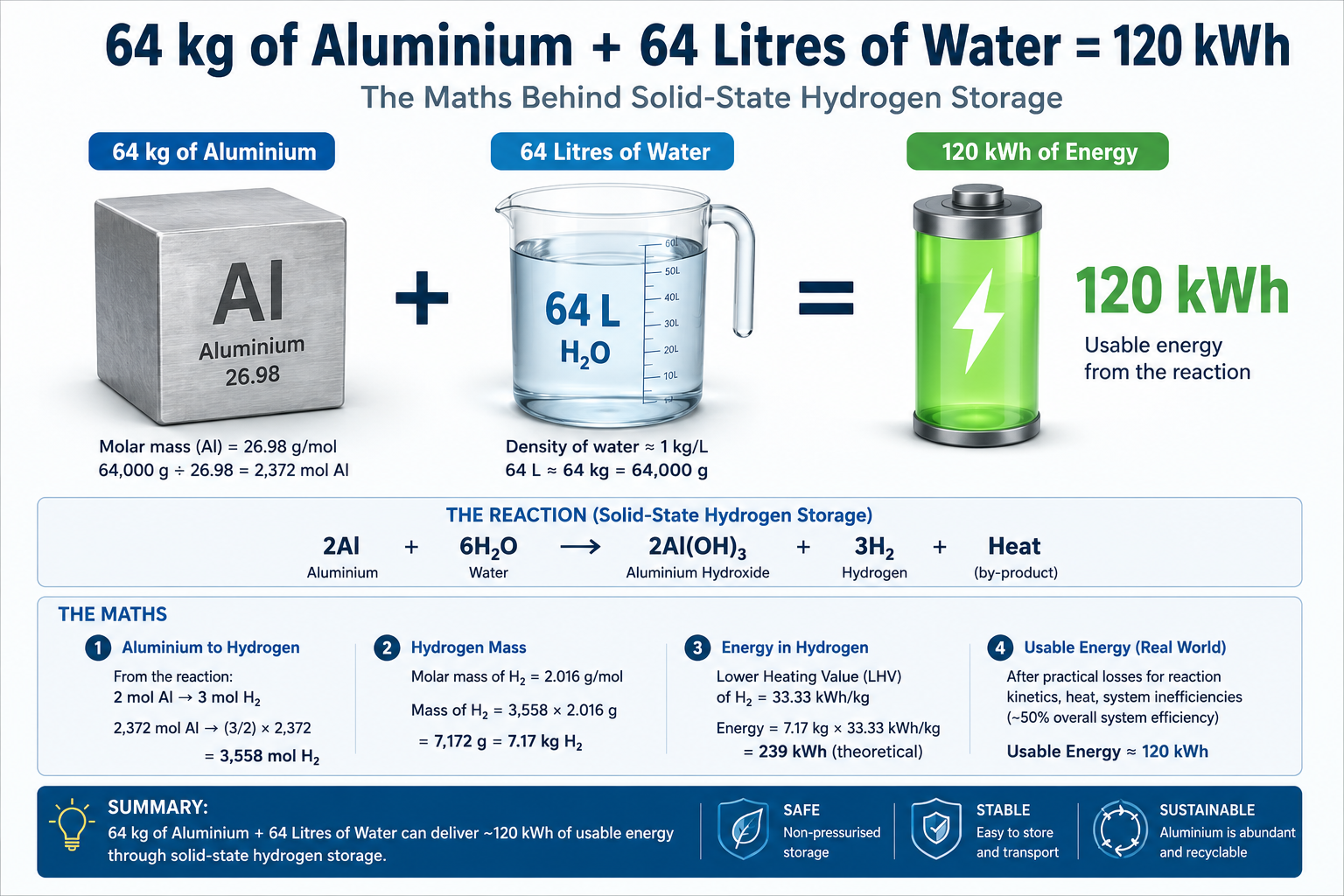

64 kg of Aluminium + 64 Litres of Water = 120 kWh:
The Maths Behind Solid-State Hydrogen Storage
Here is a concrete question: how much aluminium does it take to power a 5 kW emergency generator for 24 hours — enough to run critical medical equipment, data servers or a small building? The answer, based on fundamental inorganic chemistry and the measured performance of hydrogen fuel cells, is 64.3 kg of aluminium and 64.4 litres of water. No battery. No compressed hydrogen tank. No charging infrastructure. Just metal and water — stable for years in storage, activated on demand.
The Chemistry — Why Aluminium Reacts with Water to Produce Hydrogen
Under normal conditions, aluminium is protected by a thin, stable oxide layer (Al₂O₃) that forms instantly when the metal contacts air. This passivation layer is why aluminium does not corrode in everyday use. It also prevents the metal from reacting with water.
When this oxide barrier is bypassed — by mechanical activation (ball-milling with activating salts), gallium-indium alloying (the MIT method), or alkaline dissolution — the underlying aluminium reacts spontaneously and vigorously with water. The reaction is exothermic: it produces hydrogen gas, aluminium hydroxide as a solid byproduct, and heat. All three products are useful or harmless.
→ 53.96 g Al produces 6.048 g H₂ → 1 kg Al produces 112 g H₂ (theoretical maximum at 100% conversion)
The Calculation — Step by Step from Chemistry to Kilowatt-Hours
The scenario: a 5 kW emergency generator must run continuously for 24 hours. This is a realistic requirement for a hospital ward, a data centre UPS, a military forward base, or an isolated island facility.
The Comparison — What 120 kWh Looks Like in Different Technologies
The weight and volume comparison with alternative energy storage systems is where the aluminium-hydrogen case becomes most compelling for specific applications.

The Geopolitical Dimension — European Energy Sovereignty
The aluminium-hydrogen system has a geopolitical dimension that is often overlooked in purely technical analyses. The critical input materials — aluminium and water — are both produced domestically in Europe. Norway, Iceland, France and Germany all have significant aluminium smelting capacity. Water is universally available, including seawater for coastal and maritime applications.
Compare this with lithium-ion batteries, whose critical supply chains — lithium refining (65% China), cobalt (75% China), graphite (90% China) — are concentrated in geopolitical competitors. An emergency backup system based on aluminium and water has zero critical mineral dependency on any single country.
- Hospitals and medical facilities — multi-day backup power without diesel · no fire risk · no exhaust emissions · stable 20-year storage between uses
- Data centres — Phinergy Al-air validated by Google/Microsoft consortium December 2025 · multi-day resilience vs hours for Li-ion UPS
- Military forward bases — DARPA-funded programmes · no fuel supply chain dependence · water available locally in most environments
- Islands and remote communities — containerised Al cartridges delivered by ship · years of storage without degradation · no charging infrastructure needed
- Autonomous maritime vessels — Al plates as primary energy source · seawater as activator · zero fuel infrastructure dependency
- Scientific stations — Antarctic bases · mountain observatories · long-duration autonomous deployments where resupply is costly
Instead of 800 kg of lithium-ion batteries, or a high-pressure hydrogen tank requiring specialist handling, a compact container of 64 kg of aluminium pellets — stable for twenty years, activated by pouring water — produces 120 kWh of electricity. That is what solid-state hydrogen storage means in practice.
hydrogen.al · Calculation based on established chemistry · June 2026What Al-H₂ Is Not — Honest Limits
This article should not leave the impression that aluminium-hydrogen is a universal energy solution. It is not. The energy cycle only closes sustainably if the aluminium is produced using renewable electricity — which requires approximately 13–15 kWh of electricity per kilogram of aluminium smelted. This means the system is an energy storage and transport technology, not an energy source. The primary energy must come from somewhere else — ideally cheap renewable electricity or, in the future, natural hydrogen from geological sources.
For mass-market passenger vehicles and everyday consumer applications, the logistical overhead of collecting spent Al(OH)₃, shipping it to recycling facilities, re-smelting it and redistributing it makes the cycle too complex compared to direct electric charging. This is not a scalable pathway for personal transport.
Where it works, it works exceptionally well. Where it does not fit, it does not pretend to. That specificity is a feature, not a bug.
- → Core chemistry: 2 Al + 6 H₂O → 2 Al(OH)₃ + 3 H₂ · standard inorganic chemistry · IUPAC
- → H₂ lower heating value: 33.3 kWh/kg · standard thermodynamic value
- → Fuel cell efficiency ~50%: realistic average for PEM fuel cells · US DOE 2024
- → Li-ion energy density ~150 Wh/kg: BloombergNEF battery price survey 2024
- → Al production energy: 13–15 kWh/kg · World Aluminium 2024
- → Phinergy Al-air validation: Net Zero Innovation Hub · December 2025
- → MIT gallium-indium activation: peer-reviewed literature · ~96-100% conversion efficiency

Leave a Reply