
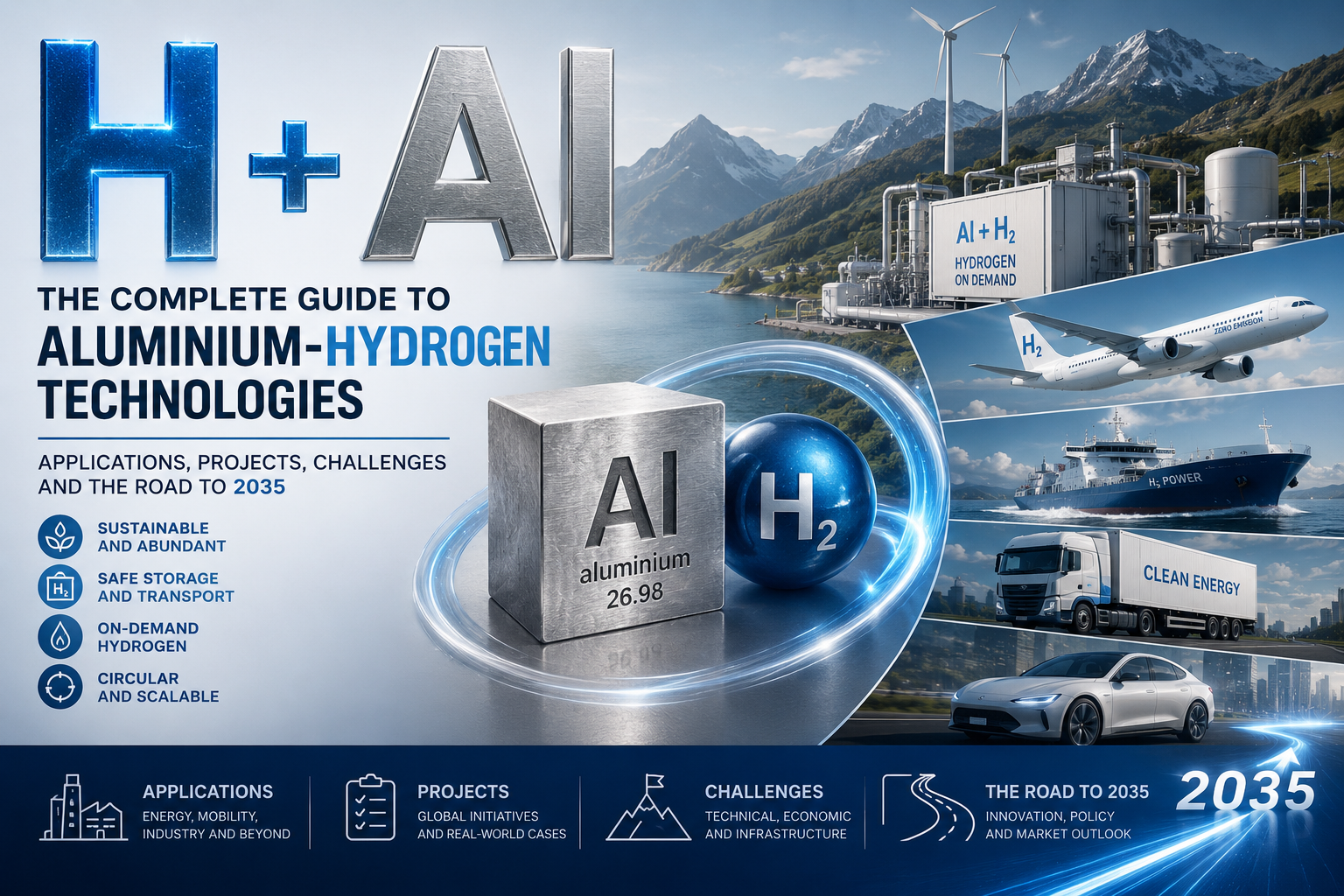

Aluminium + Hydrogen:
The Complete Guide to a Sovereign Energy Partnership
This domain — hydrogen.al — is not registered in Albania. For any chemist, metallurgist or energy engineer, it reads immediately as H (Hydrogen) + Al (Aluminium), the two universal chemical symbols for one of the most promising energy partnerships of the coming decade. This article documents everything that is currently known, confirmed, and defensibly projected about the aluminium-hydrogen couple — its chemistry, its real commercial applications, the companies building them, the honest challenges they face, and a defended timeline to 2035.
The Chemistry — What Happens When Aluminium Meets Water or Air
Aluminium is the third most abundant element in the Earth’s crust. Under normal conditions, it is protected by a thin, stable oxide layer (Al₂O₃) that forms instantly when the metal is exposed to air. This passivation layer prevents the metal from reacting — which is why aluminium does not corrode in everyday use. Breaking through this layer is the central challenge of Al-H₂ technology, and the key innovation behind every commercial application described in this article.
How Scientists Bypass the Oxide Layer — Three Confirmed Methods
Three principal methods have been demonstrated at laboratory or pilot scale to activate aluminium for reaction with water. Gallium alloying — adding a small amount of liquid gallium to aluminium — disrupts the oxide layer at grain boundaries, allowing water to reach the pure metal beneath. The MIT group demonstrated near-100% conversion efficiency at 55–100°C using this method. Gallium is recoverable and reusable, but expensive.
Alkali activation — dissolving aluminium in sodium or potassium hydroxide solution — chemically destroys the oxide layer. Simple and cheap, but produces aluminate rather than pure hydrogen gas. Mechanical activation — ball-milling aluminium powder with activating salts — creates fresh reactive surfaces before the oxide can reform. This is the method used in commercial Al-H₂ cartridge systems: stable dry powder that reacts vigorously when water is added.

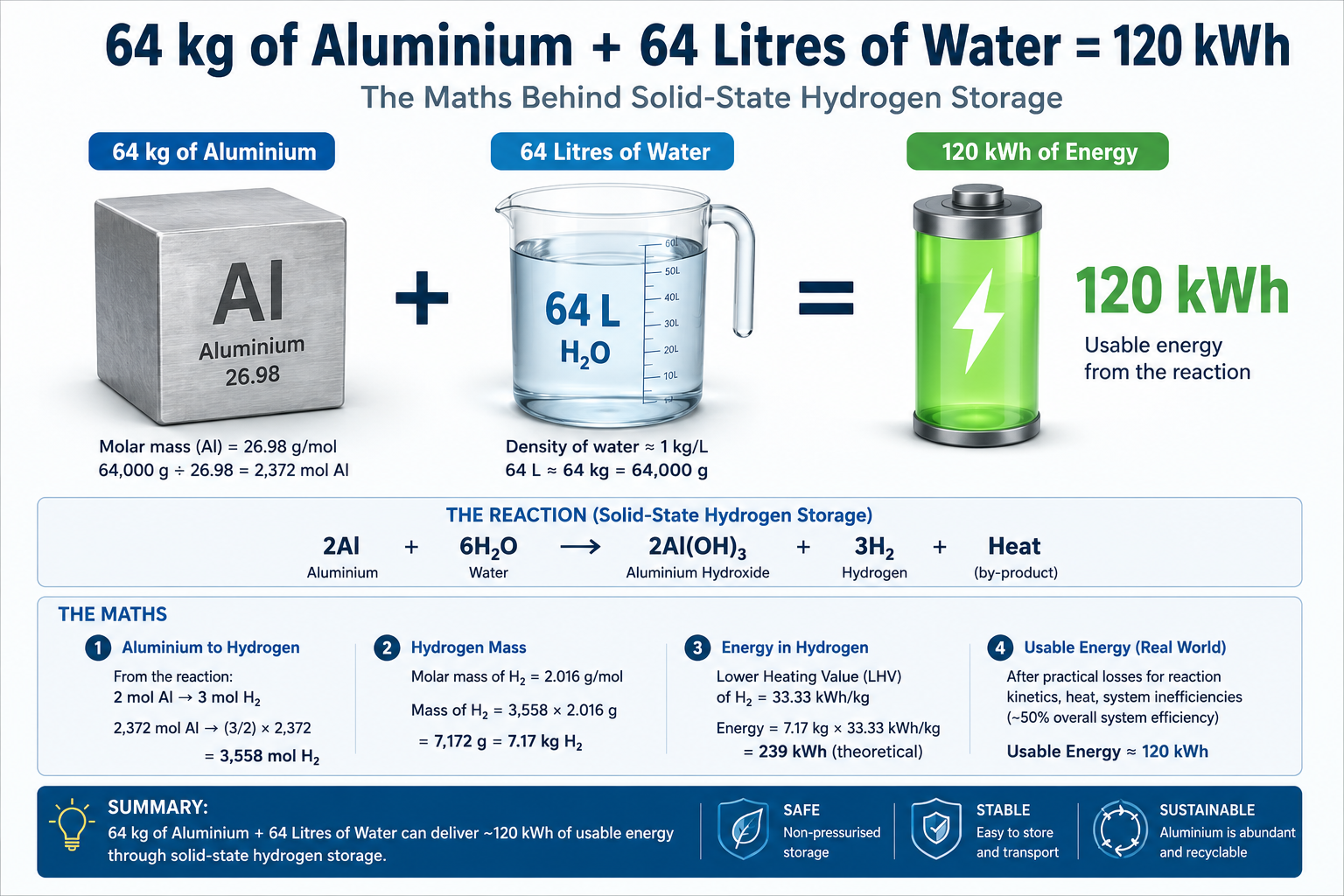
The Energy Yield — What One Kilogram of Aluminium Can Do
Six Real Applications — From Confirmed Commercial to Early Stage
The Paradox — When Hydrogen Is the Enemy of Aluminium
There is a striking paradox in the Al-H₂ story. In the five applications above, hydrogen is either the desired product or the energy carrier. But in the aluminium foundry industry, hydrogen is one of the most feared contaminants.
When aluminium is melted, it readily dissolves hydrogen from atmospheric moisture. As the metal cools, hydrogen solubility drops sharply and the dissolved gas forms microscopic bubbles — creating porosity that weakens the casting. Foundry engineers spend significant effort degassing molten aluminium using rotating impellers that bubble inert gases through the melt to carry dissolved hydrogen to the surface.
The same couple — aluminium and hydrogen — with two completely opposed industrial relationships depending entirely on the application. This is what makes hydrogen.al such an accurate chemical domain name: it captures both faces of the partnership without privileging either.

Al-H₂ vs Competing Technologies — An Honest Comparison
| Dimension | Al-H₂ System | Li-ion Battery | Solid-State Battery | Compressed H₂ |
|---|---|---|---|---|
| Energy density | High · Al: ~8 kWh/kg theoretical | Low · ~0.3 kWh/kg practical | Medium · ~0.5 kWh/kg (lab) | High · but tank weight reduces net |
| Recharge method | Plate/cartridge swap · minutes | Electric charge · hours | Electric charge · faster than Li-ion | Pressure fill · 3-5 minutes (700 bar) |
| Infrastructure needed | None · Al is everywhere | Charging network | Charging network | H₂ station network · very limited |
| Rare metal dependency | None · Al is abundant | Lithium · cobalt · nickel | Lithium · cobalt · nickel | None for H₂ · platinum for fuel cell |
| Recyclability | ~97% · Al(OH)₃ → Al | ~50% in practice | ~50-60% projected | H₂ consumed · no residue |
| Commercial maturity | Early commercial (backup power) | Fully commercial | Not yet commercial (2027-2028) | Niche commercial (buses, forklifts) |
| Best application | Multi-day backup · drones · remote | City cars · electronics | City cars · electronics (future) | Buses · heavy trucks · industry |
The Challenges — What Is Not Yet Solved
The Timeline — What Is Confirmed, What Is Projected, What Is Hypothetical
Aluminium is not just a lightweight structural metal. It is a solid-state energy carrier that the world already produces at 70 million tonnes per year, transports globally, and recycles at 97%. The energy transition does not always require new materials — sometimes it requires seeing existing ones differently.
hydrogen.al · Editorial · June 2026What hydrogen.al Means — And Why the Domain Name Is Accurate
Al is the universal chemical symbol for aluminium — from the Latin “Alumen”. H is the universal chemical symbol for hydrogen. hydrogen.al therefore reads, for any science or engineering professional, as the exact chemical formula for this technology axis. No other domain combines these two symbols as cleanly.
- H — chemical symbol for hydrogen · universal · used in every chemistry textbook in the world
- Al — chemical symbol for aluminium · from Latin Alumen · universal · ISO standard
- .al — country code top-level domain for Albania · but read chemically: Al = aluminium
- hydrogen.al — reads as “Hydrogen + Aluminium” to any chemist, metallurgist or energy engineer · not a geographic coincidence · a chemical formula as a domain name
- Uniqueness — no other domain in the world combines H and Al as a primary chemical formula · the combination is both exact and exclusive
The Honest Assessment — What We Know and What We Don’t
Al-H₂ technology is real, funded, and commercially active in specific niches — particularly Al-air backup power for data centers and Al-H₂ fuel cells for drones. Phinergy is a publicly listed company with real customers including Google and Microsoft’s data center consortium. Fives + Hydro have demonstrated H₂-fired aluminium recycling at industrial scale. These are not laboratory curiosities.
What is not yet real is the broad circular Al-H₂ energy economy — where green aluminium is produced with cheap renewable electricity, transported globally, reacted with water to produce hydrogen, and the byproduct recycled back to aluminium at low cost. This cycle is technically coherent but economically challenging at current electricity prices. The natural hydrogen opportunity in Lorraine — if confirmed at €0.50/kg — changes the economics of the entire cycle, but this confirmation is still pending as of June 2026.
The honest position: Al-H₂ is a real sector with real commercial applications, real funding, and a defensible growth trajectory in specific niches. It is not a guaranteed revolution. The timeline to broad commercial scale depends on developments — particularly cheap green or natural hydrogen — that are not yet confirmed.
- → Net Zero Innovation Hub for Data Centers + Phinergy — “Strategic Collaboration to Validate AAG” — December 17, 2025
- → Power Engineering — NYPA + Phinergy BIRD Foundation $1.5M grant — February 28, 2025
- → Hindalco Industries — “Hindalco, Phinergy and IOP to partner on Al-Air batteries” — June 2025
- → IOC Phinergy — iocphinergy.in — Al-Air battery technology · EV + stationary applications
- → Phinergy — phinergy.com — Al-air technology · applications
- → Charged EVs — Phinergy CEO interview — Al-air range extender for EVs
- → Fives Group + Norsk Hydro — “First industrial H₂-recycled aluminium batch” — June 2023
- → Commercial UAV News — Cellen H2 H2-6 drone · 150 min endurance — November 2025
- → Intelligent Energy — H₂ fuel cell UAV systems — intelligent-energy.com
- → MIT research — gallium activation of aluminium · ~100% conversion efficiency
- → ScienceDirect — “A review of hydrogen generation methods via aluminum-water reactions”
- → FDE / REGALOR II — Lorraine natural hydrogen · Pontpierre 3,655m · October 2025

Leave a Reply